A chart cluttered with 15 horizontal lines is worse than a chart with none. The Support & Resistance Engine scores every level for quality — rejection strength, volume, touch count, and age — and shows only the levels the market is most likely to respect.
Every potential support and resistance level starts as a swing high or swing low. Before being displayed, it is scored across five factors. Only levels that earn their place on the chart are shown — and if a level's score drops below your threshold, it disappears automatically.
When a level is broken, it flips — support becomes resistance and vice versa — with a score reduction to reflect the break. The engine updates in real time as the market evolves.
How sharp was the reversal at the swing point? A large wick relative to ATR indicates strong buying or selling interest. Small wicks score lower — incidental turns are not the same as deliberate institutional reactions.
Was the swing point formed on above-average volume? Institutional positioning leaves footprints in the data. High-volume swing points are structurally more significant than those formed on thin volume.
How many times has price returned to this level and held? Each successful defence increases the score. The more a level has been tested and respected, the more institutional weight it carries — up to 5 touches, after which saturation reduces the score.
Recent levels carry more relevance than old ones. A level from 50 bars ago weighs more than one from 500 bars ago — unless it has been retested recently. Old, untouched levels fade from the chart automatically.
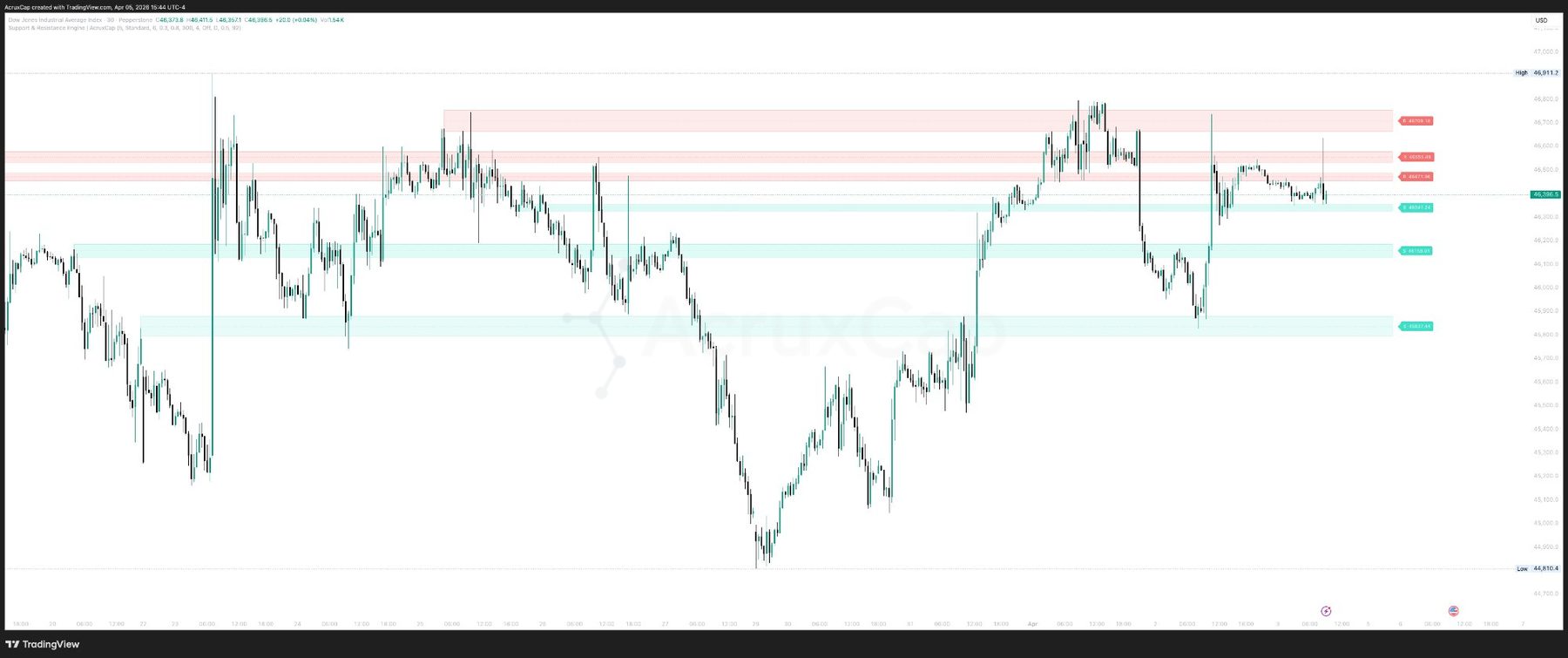
Scored support and resistance zones displayed across the Dow Jones Industrial Average — clear, uncluttered, and ranked by quality so the strongest levels are instantly visible.
Teal-filled zones mark scored support levels below price. Red-filled zones mark resistance above. Opacity scales with distance from current price — the nearest, most relevant levels are the most visible. Zones extend from their formation bar to the right edge, showing the full history of each level. Gold-bordered zones indicate confluence with the active pivot system.
Activate any classical pivot system as a secondary layer. When a pivot level aligns with a scored S/R zone, the indicator automatically highlights the confluence in gold — the highest-probability reaction points on your chart.
The most widely used institutional pivot system. PP, R1/R2/R3, and S1/S2/S3 based on prior period high, low, and close. Every institutional trader watches these levels.
Tighter intraday levels from prior close and range. R1–R4 and S1–S4. R3/S3 mark the value extremes. R4/S4 are breakout levels. Popular with scalpers and intraday reversal traders.
Central pivot with Fibonacci retracements (38.2%, 61.8%, 100%) of the prior range applied. The natural alignment of Fibonacci with swing behaviour makes these especially powerful in forex.
Similar to Classic but weighted toward the current session open. Good for traders who use opening price behaviour as a reference — the Woodie PP is calculated differently from Classic, giving different levels.
Central pivot plus Top Central (TC) and Bottom Central (BC) lines. Displays the value area for the session. Increasingly popular globally and standard practice in Indian equity markets.
Different traders need different amounts of information. Four density presets cover every style — from the cleanest possible view to a comprehensive structural map.
The Support & Resistance Engine adds structural context to any entry-based indicator. Use it alongside any AcruxCap tool or your own strategy.
Know the market phase and the key structural levels simultaneously. Take longs from scored support during Markup. Take shorts from resistance during Markdown.
Order blocks and traditional S/R are complementary. When an order block aligns with a scored S/R zone, you have two independent reasons for the level to hold.
Intraday scalping benefits enormously from clean S/R zones plus pivot overlays. Know where you're targeting before you enter, not after.
Mean-reversion signals work best when you know the structural levels price is reverting to. A VWAP reversion entry at a scored support zone is a significantly higher-conviction setup.
No. All level classifications are based on confirmed bar close data. A level shown at bar 100 will still be there when you reload the chart next week. No future data is used in any calculation.
A confluence zone is where a scored S/R zone from the swing engine aligns with a level from the active pivot system within a configurable ATR distance. The zone's border turns gold. These are the highest-probability reaction points on the chart — the level is significant both historically and mathematically.
No — deliberately. Only one pivot system is active at a time to prevent chart clutter. Choose the system that matches your trading style: Classic for institutional reference, Camarilla for intraday reversals, CPR for value area analysis, Fibonacci for forex, Woodie for opening price traders.
All timeframes from 1-minute to weekly. All liquid instruments — indices, forex, crypto, commodities, and stocks. The pivot overlay adapts to your chosen pivot timeframe (daily, weekly, monthly, or custom).
When price closes beyond a support or resistance level, it flips — support becomes resistance and resistance becomes support. The flipped level receives a score reduction to reflect the break, acknowledging that it is now a weaker level than it was before being tested.
No. S/R levels are structural reference points, not entry triggers. How you trade them is your decision. The indicator shows you where the significant levels are, how strong they are, and whether they align with pivots — the entry decision remains yours.
The Support & Resistance Engine is included in your AcruxCap Pro subscription alongside all eight indicators in the suite — free for early members during the launch period.
Free for early members · No card required · Access closes soon
The Support & Resistance Engine is a technical analysis tool provided for informational and educational purposes only. It does not constitute financial advice. Trading involves significant risk of loss.